
Install the app
How to install the app on iOS
Follow along with the video below to see how to install our site as a web app on your home screen.
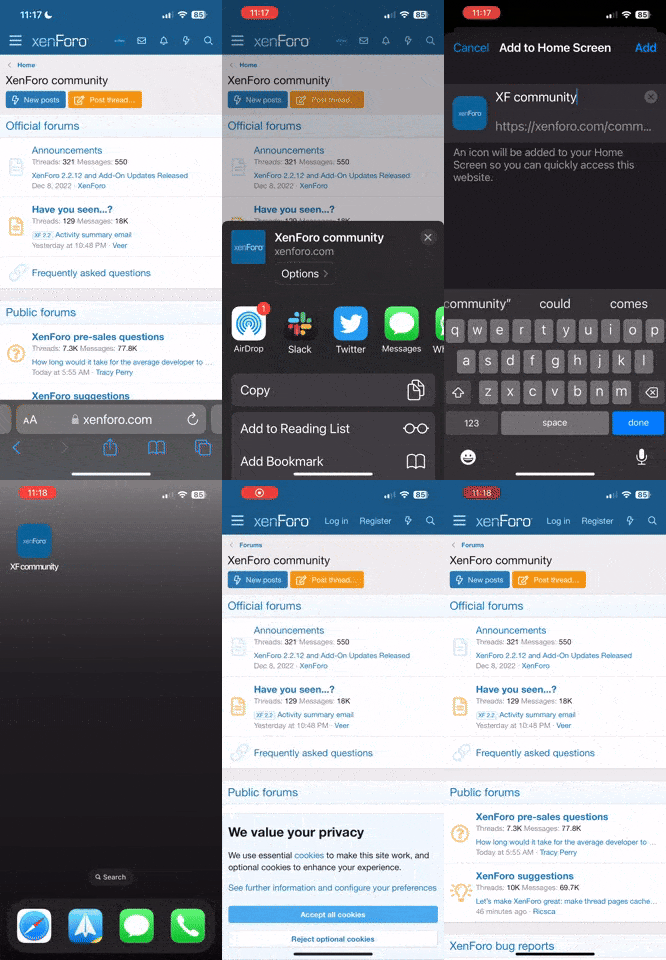
Note: This feature currently requires accessing the site using the built-in Safari browser.
You are using an out of date browser. It may not display this or other websites correctly.
You should upgrade or use an alternative browser.
You should upgrade or use an alternative browser.
UNIX? Linux? Ubuntu?
- Thread starter blade
- Start date


donkey42
plank
Ubuntu is linux, All BSDs are based on UNIX while not retaining any of the original code. Linux is a UNIX clone, which is not a bad thing, just different, See this page for a timeline of BSD / UNIXUNIX? Linux? Ubuntu?, Are they all the same?
PC-BSD and DesktopBSD are based on freeBSD, as is OS-X to a degree[ot]Its a more than interesting family tree[/ot]
hope that clear some things up!
donkey42
plank
well there are so many different linux distributions, each distro has it's good and bad points personally i use Kubuntu but PCLinuxOS, Mandriva, all 3 are good for someone new to *nixblade said:which is the best; Linux?
for example: you may prefer KDE or Gnome or one of the many window managers (WM) there are (any WM can run on any distro, unlike Win where your stuck with Redmond)
BTW: personally i prefer KDE, as do a lot of people
BTW: it's all about personal choice, check out distrowatch for a brief description of many active distros

Anti-Trend
Nonconformist Geek
"Linux" is actually the kernel -- the core part of the operating system. All operating systems have a kernel. But back on topic, since Linux is released under a free license called the GPL, anybody can create their own distribution of Linux. They all use basically the same software, though the versions, configuration, and approach to managing that software will vary somewhat from distro to distro.
This may seem confusing at first, but makes sense when you consider all the potential uses for a computer. Since each distro is created with a specific set of goals in mind, some are more specialized than others. Choice is good!
On my desktops I use Debian Linux, which has been around for a very long time and is backed by a non-profit organization. Debian's strength is in its amazing flexibility and huge repository of available software. It also has a very good package manager -- the part of the operating system that handles installing/removing software -- which is second to none. It's a good distribution for those who want easy access to very new versions of Linux software. A disadvantage of this approach is the potentially overwhelming amount of options this presents to a novice user.
On my servers, I am using CentOS (Community ENTerprise Operating System). If you've ever heard of Red Hat, CentOS is merely Red Hat without being branded with corporate logos, and backed by a community rather than a corporation. It's strengths include unrivaled stability, powerful security frameworks, and very long-term support cycles. Though all of these traits are important in a server OS, the latter is especially notewothy since server operating systems are not changed often. As such, getting current security patches for older server installations is important. In terms of updates, CentOS is one of the few operating systems who's updates can be automated and totally unattended without any problems at all. The disadvantage is that the software present has been tested long enough that it is often much older than that found in other distros. So while this is very nice for a server (where change can be bad), stale software is not much fun on the desktop (where change can be fun).
For my firewall, IPCop is my distro of choice. It's lightweight, simple, powerful, and can be administrated through an easy and secure web interface. IPCop is a very specialized distro, so it does not contain any desktop software, or any other software which is not necessary for it to be a good firewall. Until the last time I had a power outage, my IPCop had been up for well over 100 days without a reboot.
Hope this clears things up for you. :)
This may seem confusing at first, but makes sense when you consider all the potential uses for a computer. Since each distro is created with a specific set of goals in mind, some are more specialized than others. Choice is good!
On my desktops I use Debian Linux, which has been around for a very long time and is backed by a non-profit organization. Debian's strength is in its amazing flexibility and huge repository of available software. It also has a very good package manager -- the part of the operating system that handles installing/removing software -- which is second to none. It's a good distribution for those who want easy access to very new versions of Linux software. A disadvantage of this approach is the potentially overwhelming amount of options this presents to a novice user.
On my servers, I am using CentOS (Community ENTerprise Operating System). If you've ever heard of Red Hat, CentOS is merely Red Hat without being branded with corporate logos, and backed by a community rather than a corporation. It's strengths include unrivaled stability, powerful security frameworks, and very long-term support cycles. Though all of these traits are important in a server OS, the latter is especially notewothy since server operating systems are not changed often. As such, getting current security patches for older server installations is important. In terms of updates, CentOS is one of the few operating systems who's updates can be automated and totally unattended without any problems at all. The disadvantage is that the software present has been tested long enough that it is often much older than that found in other distros. So while this is very nice for a server (where change can be bad), stale software is not much fun on the desktop (where change can be fun).
For my firewall, IPCop is my distro of choice. It's lightweight, simple, powerful, and can be administrated through an easy and secure web interface. IPCop is a very specialized distro, so it does not contain any desktop software, or any other software which is not necessary for it to be a good firewall. Until the last time I had a power outage, my IPCop had been up for well over 100 days without a reboot.
Hope this clears things up for you. :)
You might want to try a distrobution chooser. It is a simple drill down to find some possibilities, although none of them repressent ALL linux distobutions or BSD flavors.
Chooser #1 (polishlinux.org)
Chooser #2 (zegeniestudios.net)
Chooser #3 (tux.org)
Try all three and compare the out come. If you really have no idea of where to start, this will help narrow the possibilities quickly.
Of course, distrowatch is a great resource once you have 3-4 possible options selected
You can also see my signature for some other choices
\/ \/ \/ \/ \/
Chooser #1 (polishlinux.org)
Chooser #2 (zegeniestudios.net)
Chooser #3 (tux.org)
Try all three and compare the out come. If you really have no idea of where to start, this will help narrow the possibilities quickly.
Of course, distrowatch is a great resource once you have 3-4 possible options selected
You can also see my signature for some other choices
\/ \/ \/ \/ \/