
Install the app
How to install the app on iOS
Follow along with the video below to see how to install our site as a web app on your home screen.
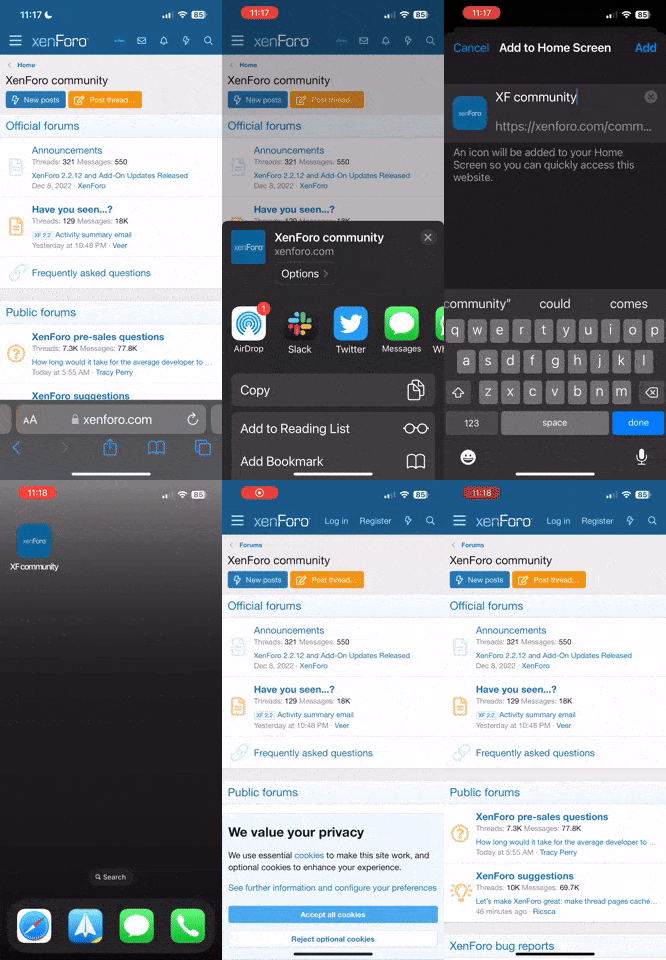
Note: This feature currently requires accessing the site using the built-in Safari browser.
You are using an out of date browser. It may not display this or other websites correctly.
You should upgrade or use an alternative browser.
You should upgrade or use an alternative browser.
VectorLinux website --Hacked!
- Thread starter megamaced
- Start date

sabashuali
Ani Ma'amin
megamaced said:Why would somebody want to hack a website that belongs to an open source, Linux distribition?
It's just pointless...
No mate, you got it all wrong.
They heard you were going to run VectorLinux on a crappy Celeron machine and repelled you from their site.... hahahahahahah!!!!! :P
They are on to you mate!

Anti-Trend
Nonconformist Geek
I wonder if they were hosting the site themselves? Many smaller distros have to rely on hosting companies since they can't afford the infrastructure and bandwidth to host it themselves. Either way, embarrasing! :O

megamaced
Geek Geek Geek!
Not getting any better for the poor guys over at Vector. They got the website back late last night, but I tried to access it this morning and now all it says is:
'Unable to select database'
Two hacks in 2 days? :eek:
Someone must really have it in for them!
It's quite annoying because I am trying to get help on their forums! Samba doesn't seem to be working properly. I am sharing a folder on my Ubuntu machine with Samba, but when I try to access it on Vector it just says 'unknown location'!
Just to be sure, what is the correct syntax for a samba address?
Is it
'Unable to select database'
Two hacks in 2 days? :eek:
Someone must really have it in for them!
It's quite annoying because I am trying to get help on their forums! Samba doesn't seem to be working properly. I am sharing a folder on my Ubuntu machine with Samba, but when I try to access it on Vector it just says 'unknown location'!
Just to be sure, what is the correct syntax for a samba address?
Is it
Code:
smb://192.168.1.xxx/share
Matt555
iMod
Not neccessarily a hack, maybe they're just having database problems, maybe the connection to the database isn't set properly, maybe the config isn't right, who knows.megamaced said:Not getting any better for the poor guys over at Vector. They got the website back late last night, but I tried to access it this morning and now all it says is:
'Unable to select database'
Two hacks in 2 days? :eek:
Someone must really have it in for them!
Anti-Trend
Nonconformist Geek
I'm still trying to figure out why you're using Windows file & print sharing to share files with another *nix. You should be using NFS for this purpose, as it's faster with less overhead.megamaced said:It's quite annoying because I am trying to get help on their forums! Samba doesn't seem to be working properly. I am sharing a folder on my Ubuntu machine with Samba, but when I try to access it on Vector it just says 'unknown location'!
That depends, are you trying to browse the SMB share with Konqueror? If so, try smb://xxx.xxx.xxx.xxx/ --OR-- smb://$NETBIOSNAME/megamaced said:Just to be sure, what is the correct syntax for a samba address? Is itCode:smb://192.168.1.xxx/share
If you still get no love, try scanning your Vector box with nmap and see if port 445 is actually accepting connections and your Vector box isn't firewalled or anything. If your firewall is down and 445 is actually closed (e.g. there's no service running there), you probably need to start or restart the Samba service on that machine.
megamaced
Geek Geek Geek!
Anti-Trend said:I'm still trying to figure out why you're using Windows file & print sharing to share files with another *nix. You should be using NFS for this purpose, as it's faster with less overhead.
Ummm :confused: Yeah, why didn't I think of that! :O
What is the correct syntax for an NFS share?
By the way, I am trying to use XFCE (Vector) to browse a shared folder on GNOME (Ubuntu).
Anti-Trend
Nonconformist Geek
NFS is mounted like any other data volume in your /etc/fstab. Here's some documentation to help you get started, in both basic and extensive flavors. :)megamaced said:What is the correct syntax for an NFS share?
Basically, one machine exports certain directories or volumes via NFS, and the other system mounts those resources as a directory someplace on their system. Here's a sample from the /etc/exports on my home file server:
Code:
/home/common 192.168.25.0/255.255.255.0(rw,async,all_squash,anonuid=1000,anongid=1000)
/home/incoming 192.168.25.0/255.255.255.0(rw,async,all_squash,anonuid=1000,anongid=1000)
/home/antitrend 192.168.25.101(rw,async,all_squash,anonuid=500,anongid=500)
/home/somebody_else 192.168.25.100(rw,async,all_squash,anonuid=501,anongid=501)Here are the corresponding entries in one of my client system's /etc/fstab to give you a little more illustration:
Code:
192.168.25.5:/home/common /mnt/server/common nfs rsize=8192,wsize=8192,nosuid,soft 0 0
192.168.25.5:/home/incoming /mnt/server/incoming nfs rsize=8192,wsize=8192,nosuid,soft 0 0
192.168.25.5:/home/antitrend /home/antitrend/remote nfs rsize=8192,wsize=8192,nosuid,soft,user 0 0
megamaced
Geek Geek Geek!
It's all up and running now :)
I managed to set up SuSE and Ubuntu as a client/server pretty easily but there were a few problems with VectorLinux. Basically none of the NFS services were installed so I had to slapt-get 'nfs-utils' and initialise them one by one! Although it's working on Vector now, there is one service that I couldn't start called 'rpc.rquotad'. I don't know whether this is supposed to come with the nfs-utils package or not, but I can't find it in /sbin or /usr/sbin. What does it do and do I actually need it? As I said before, I am able to share files as it is.
I assume this means that only the user who's ID is 1000 can use this service?
I managed to set up SuSE and Ubuntu as a client/server pretty easily but there were a few problems with VectorLinux. Basically none of the NFS services were installed so I had to slapt-get 'nfs-utils' and initialise them one by one! Although it's working on Vector now, there is one service that I couldn't start called 'rpc.rquotad'. I don't know whether this is supposed to come with the nfs-utils package or not, but I can't find it in /sbin or /usr/sbin. What does it do and do I actually need it? As I said before, I am able to share files as it is.
AT said:Code:anonuid=1000,anongid=1000
I assume this means that only the user who's ID is 1000 can use this service?
Anti-Trend
Nonconformist Geek
Good job. :)megamaced said:It's all up and running now :)
The quota daemon can enforce user's disc space quotas on your system. This is so on shared resources, one user can't fill up the entire partition and leave none for everyone else. You really don't need this in a single-user environment.megamaced said:... there is one service that I couldn't start called 'rpc.rquotad'. I don't know whether this is supposed to come with the nfs-utils package or not, but I can't find it in /sbin or /usr/sbin. What does it do and do I actually need it? As I said before, I am able to share files as it is.
Yes, my user mapping on my local machines are different from that on my server, so I use that to force the correct UID. "all_squash" disregards the UID on the client machine, forcing them to connect anonymously, and the "anonuid" and "anongid" entries specify what I want the anonymous user and group ID's to be. Make sense? As for the "async" entry, that makes it perform faster.megamaced said:I assume this means that only the user who's ID is 1000 can use this service?

Karanislove
It's D Grav80 Of Luv
megamaced said:Why would somebody want to hack a website that belongs to an open source, Linux distribition?
Just to check how strong they are because Linux is the worlds best secured windows and its very difficult to hack it.
megamaced
Geek Geek Geek!
Just two more things I need to know :)
The 'rsize' and 'wsize' options increase the buffer and improve network performance? What do you think a good size would be for a standard 100Mb/s network? I've got 3 computers that connect to a 100Mb/s switch in a peer-to-peer. The switch connects to a router but my landlord controls that.
Also, what security measures have you taken to protect your network?
Hehe, don't get the wrong end of the stick - I am not testing the water, so to speak ;) I would like to know so I can take similiar steps.
I've set up a firewall on all machines, and I've edited the 'hosts.allow' to accept only the IP addresses of my machines. I have also edited the 'hosts.deny' file to include:
The 'rsize' and 'wsize' options increase the buffer and improve network performance? What do you think a good size would be for a standard 100Mb/s network? I've got 3 computers that connect to a 100Mb/s switch in a peer-to-peer. The switch connects to a router but my landlord controls that.
Also, what security measures have you taken to protect your network?
Hehe, don't get the wrong end of the stick - I am not testing the water, so to speak ;) I would like to know so I can take similiar steps.
I've set up a firewall on all machines, and I've edited the 'hosts.allow' to accept only the IP addresses of my machines. I have also edited the 'hosts.deny' file to include:
Code:
portmap:ALL
lockd:ALL
mountd:ALL
rquotad:ALL
statd:ALL
Anti-Trend
Nonconformist Geek
On a 100MiB network, I've found 8192 works very well for both.megamaced said:Just two more things I need to know :)
The 'rsize' and 'wsize' options increase the buffer and improve network performance? What do you think a good size would be for a standard 100Mb/s network?
I'm not paranoid about my security because I setup my network with security in mind. In so far as the hosts.deny goes, it looks good. That being said, you need just about every one of those services to be reachable by your NFS clients. On any machines which are sharing files via NFS, you should have an entry in the hosts.allow for each of your machines which will connect as clients.megamaced said:Also, what security measures have you taken to protect your network?
Hehe, don't get the wrong end of the stick - I am not testing the water, so to speak ;) I would like to know so I can take similiar steps.
I've set up a firewall on all machines, and I've edited the 'hosts.allow' to accept only the IP addresses of my machines. I have also edited the 'hosts.deny' file to include:
Code:portmap:ALL lockd:ALL mountd:ALL rquotad:ALL statd:ALL
Why would somebody want to hack a website that belongs to an open source, Linux distribition?
It's just pointless...
i hacked this site cuz this site very importand they are give all users secure programs , scripts, or ......... but not important for them you hacked or not just they wanna earn money.. so i hacked that site by me my sanal name xcorpitx
and thıs s victorlinux miror index
http://www.zone-turk.net/deface_mirror/?id=17144